I became vegetarian about 5 years ago. Very shrtly afterwards I became a vegan. I have since fallen off the wagon and eat cheese and eggs. I LOVE CHEESE. Nonetheless vegansism and vegetarianism are the best way to reduce you consumption of fossil fuels among other things. There is a doco coming out soon called PlanEAT about how the food we eat impacts the planet. Watch the trailer below.
It's been ages since my last post (sounds like confession to the priest). I have been writing my thesis so have not had much time for blogging lately.
Here is something that I read today. It explains how I felt in my last post about the disparities within christianity. Again I stress the point about god's infallible nature. If god were all powerful, with complete power over the universe there is no way this could happen. His word should not lead to confusion. All people who read it should interpret it the same way. And, if they don't god should magically make them understand it in the same way.
Here are some bits that I like from the above link
Some of us, on the basis of our relationship with God, knew him to be loving, compassionate, generous, always reaching out to us, pitying our mistakes rather than condemning them. Others, on the basis of their relationship with God, knew him to be angry, jealous, punitive.
Some of us knew that God had more important things to worry about than our sex lives; others knew that human sexual impurity was deeply offensive to him.
Some of us knew that God wanted us to respond to other people’s shortcomings with tolerance and forbearance and humility; others knew that he wanted sin to be made an example of, to be held up and publicly rebuked.
Some of us knew that God was offended by conspicuous consumption when so many people had nothing; others knew that God showered wealth along with other good things on those of whom he approved.
Some of us knew that God saw all religions as different expressions of people’s yearning for him; others knew that traditional, orthodox Christianity was the only route to him.
Some of us knew that the devil was just a myth to explain the existence of evil; others knew that the devil was very real and a genuine threat to our souls.
Some of us knew that there was no way God could ever allow such a thing as hell; others knew that hell was very much a part of God’s ordained order.


I have often heard the argument that religion or belief in the supernatural does not harm, from religious and non-religious alike. I have also had a discussion in which it was suggested that people are free, and should be free to interpret their particular holy texts in the way that 'suits' them. These two points are both fallacious, the first being completely, and the second is not in line with fundamental and underlying elements of the current large, popular religions.
I have recently thought quite a bit about these two points, but this morning, while scanning the news paper (dangerous I know) I noticed two articles that reminded me of the first point. The first article 'Church and and state war over condom plan' relates to the archaic and completely irrational doctrine contraception in the catholic church. People have sex. Sex makes babies. Sex is also a 'vector' for disease, most frighteningly HIV/AIDS. Condoms can prevent both of these things. Sure babies are great for those who can afford to have them, and I mean afford in a broad sense not just financially. The world is overpopulated and we are struggling to provide even the most basic human needs in some cases. Yet clowns like the ex-boxing champion Manny Paquiao make stupid statements like this: 'God said go forth and multiply. He did not say just go and have one or two children.' What an idiot! The Filipino catholic church want to excommunicate the president because he wants to give out free condoms. He should be grateful that the church want to publicly separate themselves from him. Who would want to be associated with idiocy like that?
The second article I saw related to a suggestion to introduce sharia law to Australia. I know very little about sharia except that it is a set of principles or a code of conduct for muslims. Also, it covers much of the same areas of law as secular laws with some other inclusions. There are apparently four schools of sharia that vary in their level of conservatism among other things. Nonetheless, I do not want to discuss sharia since I am largely ignorant of it. I do however, want to point out the impact the above suggestion in Australia has had. Given the events of recent history regarding terrorism and the demonisation of Islam, it is unsurprising that the crazies have come crawling out of the woodwork in opposition of the idea including: right wingers, jews and christians according to the article. The christian outcry is the most hypocritical. If you have time watch the video to see why. Otherwise go to pharyngula to read a brief summary. While agree that it might not be the same group or people opposing the idea of sharia in Aus, they still represent a collective who identify themselves with a common core philosophy. The same way that extremists tar all muslims with the same extremist brush.
Abrahamic religions have monotheistic beliefs, and this one god is regularly purported to be just, unchanging and infallible. However, apply a little scrutiny and these characteristics fall apart. God is just. I have discussed this in another post about morality and religion, and atrocities at the hand of god in the bible, most of which fall in the old testament and thus the torah. God is unchanging. I also mentioned this in the morality post. Here we see an old testament god hell bent on destroying huge numbers of enemies in genocides, not to mention flooding the entire earth killing every human being, except Noah and his family. And then in the new testament Jesus claims that if we are struck on the cheek, rather than killing the enemy, we should turn the other cheek. God is infallible. This can be developed from the last point about extremists and different groups within religions. God had a direct hand in influencing those who wrote religious texts, yet so often these texts are interpreted in vastly different ways. Extremist muslims and their acts of terror against infidels is one example. Another is immediately relevant. According to a group in the US that have done some excellent calculations based on dates or numbers (not too sure and not interested in reading about it) gleaned from the bible, Saturday 21 May is Judgement Day. The surprising thing is that other churches or groups haven't picked up on this, despite it being clear as day in the bible - according to Mr. Harold Camping at least. How does an all powerful, infallible god allow this to happen? Who is right and who is wrong? Will I still be here on Monday? I hope, and suspect i probably will, that I am because my wife and I are finally moving out of my mum's place.
Following on from the previous post here is a video of the famous kakapo male, Sirocco partaking in a bit of the old interspecies, homosexual proverbial in-out-in-out. Maybe this is why their numbers are so low. They can't tell head from tail (excuse the terrible turn of phrase, had nothing better).
A recent paper published in Frontiers in Ecology and the Environment (Clements et al. 2011) and subsequent press releases in New Zealand has resulted in a some public backlash. The paper proposes a new index for assessing the extinction risk of a species called SAFE (species ability to forestall extinction). In the paper the authors tested the strength of the SAFE index at predicting the most commonly used species threat measure, the International Union for Conservation of Nature (IUCN) Red List, and found it to perform better than other currently used measures.
The SAFE index is really quite simple. It takes into account two things, the total number of individuals in a species across it's entire known range and, the minimum viable population (MVP) of a species. The minimum viable population is the lowest number of individuals a population needs to sustain itself. A few years ago a cross species review of MVP and found that on average MVPs are around 4169 individuals (Traill et al 2007). The importance of this with regard to extinctions is obvious. If a species population size drops below this minimum, the chances of extinction are greatly increased. See I told you it was simple.
However, the backlash in New Zealand about this work was largely from ill informed people who have a chip on their shoulder. What chip you ask? Well it so happens that the authors of the SAFE paper are based at Australian institutions. So what? Well the crux of the story stems from the misrepresentation of the work and how it can be applied in a real world situation. Professor Cory Bradshaw was one of the authors who worked on the paper and talked about the work on radio here in NZ. There were also some news articles, one entitled 'Let the wonderfully wierd kakapo die--scientist' specifically got me riled up. The kakapo (pictured above) is a very unique bird in that is a flightless, nocturnal parrot, the only one of its kind in the world, but like so many NZ birds, it is endangered. And according to the SAFE index, with only 131 individuals of the species left, it has little chance of being saved. Luckily there are a huge number of dedicated people, both paid and volunteers, who are trying to get this bird back on it's feet. What Corey Bradshaw had to say was what people hated. He said that the massive expenditure on saving a single species that fell short on the SAFE index is unjustified because, where financial resources are limited, this happens to the detriment of countless other species. The other species may not be endangered but could be on the verge and thus excluded from the conservation effort. Therefore, by the time we realize that these species are becoming rare it may be too late, one because we spent too much money on a single species and don't have much left, and two because they may already be below the MVP threshold.
You could go and read some of the comments on the news article but I have picked out some of my favourites:
This one is priceless for a couple of reasons. Firstly they cite positive as people who are slandering Corey Bradshaw, and secondly he talks about Darwineans. I think what he means is darwinians, but I have no idea what he means by it, particularly when he talks about saving money etc.
---------------------------------------------------------------------------------------------------------------------
The SAFE index is really quite simple. It takes into account two things, the total number of individuals in a species across it's entire known range and, the minimum viable population (MVP) of a species. The minimum viable population is the lowest number of individuals a population needs to sustain itself. A few years ago a cross species review of MVP and found that on average MVPs are around 4169 individuals (Traill et al 2007). The importance of this with regard to extinctions is obvious. If a species population size drops below this minimum, the chances of extinction are greatly increased. See I told you it was simple.
 |
| Photo credit: Shane McInnes, winner of The Worlds Rarest Birds photo competition |
You could go and read some of the comments on the news article but I have picked out some of my favourites:
This one is priceless for a couple of reasons. Firstly they cite positive as people who are slandering Corey Bradshaw, and secondly he talks about Darwineans. I think what he means is darwinians, but I have no idea what he means by it, particularly when he talks about saving money etc.
Another classic. I love how she calls him a "so-called 'scientist'". And then goes on to attack him because he is Australian. If she had not just read the crap title of the article and bothered to find out about the source material she would ave realised two things. One, that Corey Bradshaw is a "real" scientist who is highly published and respected in his field, and two, that he is in fact Canadian who now lives in Australia. Additionally, he did his PhD in New Zealand.
Glad to see so many positive (save the Po) comments, but am surprised at the number who agree with the Aussie! NZ has saved a bird before, and hopefully we will do it again. To those of you "Darwineans" who are against "wasting money" saving it....think of all the money we waste trying to save other humans?? Is that a waste too? Should the NZ government let nature take its course next time you have a treatable illness or injury?
Please everyone, don't give this so-called 'scientist' another minute of our time. BUT, I guess if we don't, he will think "yeah, no one is commenting about my statement" so he'll think we really don't care about saving our lovely little kakapo. wrong !!!! Keep your Aussie BS to yourself....Comments about being Australian were really common. Here's a couple more. These ones are the most ridiculous. Real geniuses!
As many others have said, how about the Australians keep to their own country?! Australia has their own problems to watch out for!The worst part about this is obvious slant the media took and by having a title like it did, peoples minds were made up for them before they actually had any understanding of the topic.
Typical comment from an Australian i mean they have a history with there Native people as well.
---------------------------------------------------------------------------------------------------------------------
Clements, G. R., Bradshaw, C. J. A., Brook, B. W., & Laurance, W. F. The SAFE index: using a threshold population target to measure relative species threat. Frontiers in Ecology and the Environment, preprint.
Traill, L. W., Bradshaw, C. J. A., & Brook, B. W. (2007). Minimum viable population size: A meta-analysis of 30 years of published estimates. Biological Conservation, 139(1-2), 159-166.
I just read a post on Homologous Legs on bisexuality that reminded of a film I watched some months ago about Alfred Kinsey. Kinsey was an entomologist worked with gall wasps (Cynipidae) but, it was his work in human sexuality that he is best known for. In the 1930s, Kinsey became interested in human sexuality and began to pursue research in order to classify human sexual practices. The thing that I, and I am sure many others would find interesting is, "What is normal?"
The ideas around what is normal is something that I have thought about quite a bit. People think they know what is normal and anything that deviates from their normality is just that, deviant or perverted. Kinsey and his colleagues addressed this by anonymously interviewing subjects about their sexual activity and preferences. The results were quite surprising with 'non-normal' activities proving quite 'normal'. Of particular interest was the apparent prevalence of bisexuality in men. This led to the development of the Kinsey Scale where sexual preference is viewed not as binary (i.e. gay or straight) or possibly three dimensionally, but more spectrally. In other words, zero on the scale is exclusively straight, and six is exclusively gay. What Kinsey and his colleagues found was that the majority of subjects fell outside of the exclusive zero or six, and had at least some bisexual tendency. That is not to say everyone acts on these feelings, but they are at least present.
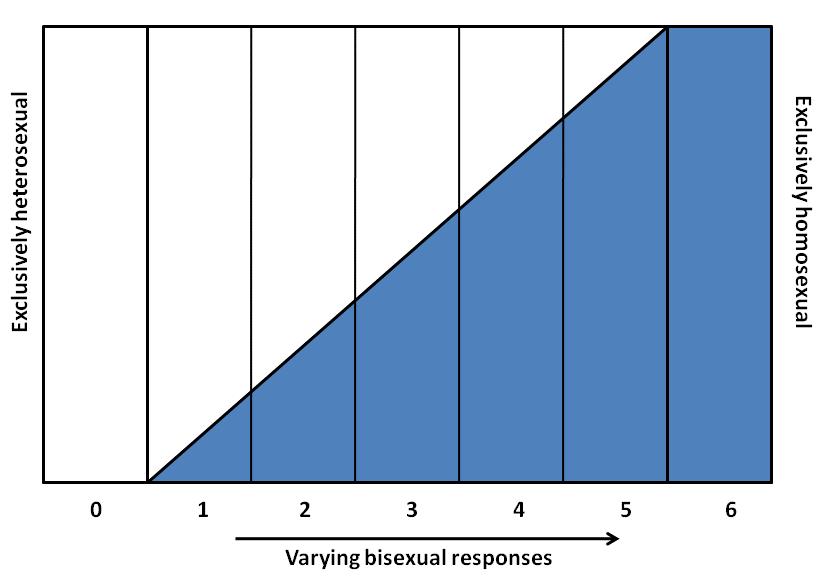 |
| The Kinsey scale of sexual preference: Image from Wikipedia |
Ernst Mayr is one of biology's greatest sons (can I say that he is a son of biology?). He made many contributions to evolutionary biology, in particular, the biological species concept. The obvious outcome of this was that it allowed biologists to draw a line in the sand and say that this is this species and this is another species, although some argue that it is arbitrary and is more problematic than useful. For example, it is possible for two defined biological species to interbreed (hybridize) and have viable, fertile offspring. Commonly, people will cite lions and tigers hybridizing (the infamous Napoleon Dynamite Liger) in zoos or other man made facilities. However, this is highly improbable in a contemporary world since everybody knows (?) that tigers live in Asia and lions in Africa. None the less, it does speak to the potential power of the process. But, if we are in search of viable hybrids, we need to think less like a human. By this I mean we need to steer away from charismatic organisms and look at other life forms. Plants are a great place to start. There are countless example of naturally occur plant hybrids, and excitingly it occurs at relatively high taxonomic levels (i.e. inter-genus and even inter-familial hybridization). There are also examples of interfamilial bird hybrids such, particularly in the unfortunately named game birds.
I seem to have digressed from my initial topic but species concepts and modes of speciation are currently a particular interest of mine. Anyways all i really wanted to say was that Ernst started out as a bird watcher as a young man. He discusses it in the video below. I really love how, even though he is his 90s, he tells the story of observing a rare bird with such excitement, as though it was yesterday. The video comes from Web of Stories which is a website with videos of a wide range of interesting and influential people, including Ernst Mayr. The videos are broken down into small digestible sections only a few minutes long and are definitely worth a look.
Here is a piece Mayr wrote for Science in 2004 when he was 100 about the Modern Synthesis. He died the following year. Even after 100 years, 81 of which were spent as a student of biology his hunger for discovery, evolutionary biology in particular, is beautifully revealed by his last sentence "I only regret that I won't be present to enjoy these future developments".
Subscribe to:
Posts (Atom)

 Posts


